

On July 17, 2025, Museum Director Lori Wysong presented the following speech to the Jefferson County Commission.
To watch the speech, click here.

The Jefferson County Courthouse c. 1875
Thank you so much to the Jefferson County Commissioners for inviting me to speak.
My name is Lori Wysong, and I am Director of the Jefferson County Museum.
I’m here tonight to speak to you about an idea for the re-use of our County’s historic
Courthouse once the county moves the court facilities to their new home. I’m sure I
don’t have to emphasize that this building is a priceless piece of history. And we are
presented with what is probably an opportunity that will only happen once in our
lifetimes—the chance to ensure that this building gets the future it deserves with a use
that preserves and honors the history it represents.
I can’t say that the idea I’m going to present here is an original one. In fact, it’s been
brought up to me by so many different people over the last several months that it
seems like a most natural and fitting purpose for the courthouse and it is one that you
all may have thought of yourselves.
That idea is, of course, the Courthouse as a future home for the Jefferson County
Museum.
Picture this, you enter the historic Jefferson County Courthouse and are welcomed into
a site where history was made. Before you is a timeline of Jefferson County’s past, a
selection of fascinating exhibits on different topics in not just local, but national history,
featuring one of a kind artifacts and artworks that help tell these important stories.
Travel further into the space, and you can access archival collections for research on
history or genealogy. Head upstairs, and you can take a virtual tour of the bell and
clock tower, as well as an in-person tour of the historic Courtroom. You’ll learn about
the West Virginia Miners Trials of 1922, the Civil War Battle that destroyed the
previous courthouse in 1863, and the trial of John Brown and his men, which took
place there just a few years earlier in 1859.
If you go back even further into history, the original Courthouse was built in 1803 on
land donated by Charles Washington. When he died in 1799, Washington’s will gave
the lots on the Town Square, formed by George and Washington Streets, to the
formation of a new county seat, with the stipulation that they be used for public
purposes. Barring its continuation as a County facility, any future usage should keep
this building open to the public and interpret its rich history, as well as that of the
County it represents. The adjacent jail, which survives today due to the foresight of
preservationists, is a natural extension of the courthouse building and would be an
asset to the Museum in the event that we moved there.
The Jefferson County Museum is part of Old Charles Town Library, Inc., a nonprofit
with a history that extends all the way back to 1927 and encompasses the Museum
and the Charles Town Library. The Museum, now in its 60th year, has a long
institutional history and a vast collection of objects, archives, and photographs
pertaining to Jefferson County’s history. Many of the items we have on display are of national importance, and deserve exposure to a broader public. If you’ve visited,
you’ve probably seen a letter written by George Washington after his brother Charles
died, the wagon that carried John Brown to his execution, and the uniform of Frank
Buckles, the nation’s last surviving World War I veteran. This collection, housed in a
National Historic Landmark with such rich history, would be an excellent way to
showcase Jefferson County’s most unique and important asset: which truly is its
history. The building itself would become an important historic artifact, one well worth
coming to view.
This is an idea that benefits not just the County and the Museum, but the citizenry as a
whole.
Working at the Museum front desk, I am constantly asked by visitors whether they can
go in the courthouse. Whether they can tour the courthouse. Whether there are any
displays to see in the courthouse. The answer to these questions should, and could, be
a resounding yes. Opening it to the public as a Museum would make it more
accessible than it ever has been. Moving the Museum to the Courthouse and Jail
buildings would give us time and the perfect opportunity to evaluate our exhibits,
collections, and displays, and to get feedback from the local community about what
they want to see more of from their local museum as we move to a location that truly
represents the history of the entire county. In addition, the extra space would be much
more conducive to expanding and diversifying our collection, and to hosting field trips
from local schools, and tour groups from outside the county.
Right now, there are countless visitors to our county who come for Harpers Ferry,
which with its history and beauty is well worth seeing, but then leave without venturing
any further into the county. Having a destination as impressive and historic as the
Courthouse would be a visible, tangible reason to drive 10 minutes further into the
county and to learn more about our local and national history.
People will be stopping along the way to eat, shop, get gas, and may even stay an
extra night in the county. This is an ideal place to educate them not only about
Jefferson County’s rich history, but about the other places and activities it has to offer,
a front line for tourism and economic development.
With all the benefits associated with the Museum, it’s no wonder that so many people
have had the same idea for this space. The question is not whether this should
happen, but how?
I’m sure as I’ve been speaking many of you have been wondering this. This will be a
big step for all involved, and to do it right it will be a complicated undertaking. To make
this a reality, we will need the support not only of the County Commission, but of all our
local municipalities and state entities such as the Department of Tourism and the State
Historic Preservation Office. The preservation of this building is something that
concerns us all, and the Jefferson County Museum hopes to create a coalition of interested stakeholders to offer long-term support in that endeavor. These include, as
I’ve mentioned, local and state governments, but also historical and cultural
organizations and clubs to provide support and expertise for the initial renovation
project and long-term preservation of the building.
One practical way we’ve come up with to support the building’s maintenance is to rent
parts of the space not used for the Museum. The judge’s chambers in the upstairs part
of the courthouse would make ideal office spaces, and the connecting jail allows a
separate, private entrance for tenants to these spaces. The historic courtroom, when it
is not open to the public, could be rented out for lectures, performances, private
events—even weddings.
There is precedent for these sorts of arrangements. The Entler Museum in
Shepherdstown operates by renting out offices and event spaces in its building. We’ve
also spoken with a Courthouse-turned-museum in Berrien Springs, Michigan, which
rents out its historic courtroom under a similar arrangement with their county.
Closer to home, we have an example of a courthouse-turned-museum with the Civil
War Museum in Winchester. This one operates under a different model, but over the
course of the years its been open, has done a terrific job renovating and fundraising for
the space.
Our county can draw from these and many other examples to create and sustain a
state-of-the-art Museum space that will give our incredible history its due.
The Courthouse’s National Historic Landmark status, along with the specialized areas
of history to which it connects, make it an excellent candidate for grant and funding
opportunities. We’re hopeful that there are many public and private sources of funding,
on both local and national levels, which would support our efforts to create and sustain
a Museum in this space.
If given the opportunity to relocate the Jefferson County Museum into the Courthouse
and jail, our nonprofit, OCTL, would seek out architectural and design services to adapt
the first floor of the buildings to its needs and make it a welcoming museum space for
the public, allowing for the development of a more concrete vision of any changes
needed and the funding required. We would then take steps to raise funds for the
necessary renovations from public and private sources, using the time available to us
to plan for the future and be ready to make these changes when Jefferson County
moves its court to its new home.
Before we can do that, we need a few things to happen. This includes further exploring
the jail building, gathering information about square footage and utility costs for both
the Courthouse and jail, and gaining a clear understanding of the timeline for the
renovation and move of the County offices and courtroom to their new facilities.
We formally invite the County Commissioners to visit the Museum, to take a look at our
current displays, and meet our board members, who have unanimously approved the
exploration of this exciting possibility.
Finally, we will have to discuss what type of arrangement for the ownership and
maintenance of the property is most suitable for Jefferson County and other interested
stakeholders. We look forward to talking with many of you about your ideas and
concerns, and brainstorming the future of the Courthouse as Museum.
Once we receive some assurance that Jefferson County is indeed interested in
pursuing this possibility, we can begin the process of making this idea– which so many
of us share–a reality, and transforming the Courthouse into the future home of the
Jefferson County Museum.
Thank you for your time and consideration of how to best handle the rare opportunity
we are faced with.
Want to help make this a reality? Laying the groundwork to move into the Courthouse means supporting the financial standing of our organization. Donate here.
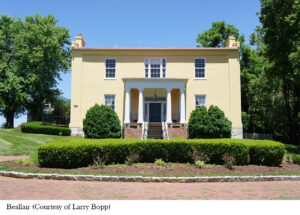 On the 6th of November 1860, Lewis and Ella Washington were wed at her family residence of Clover Lea in Mechanicsburg, Virginia. Shortly thereafter, they moved to Beallair in Jefferson County to establish their home together.
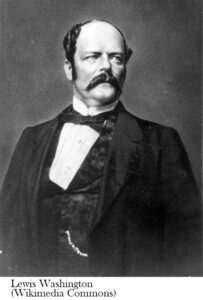 In October of 1859, Lewis rose to prominence when he was taken hostage by members of John Brown’s provisional army, who liberated men Lewis enslaved and confiscated heirlooms passed down from George Washington. Lewis was held in the Harpers Ferry Armory’s engine house as a captive and was finally freed when US Marines stormed the building. He put on a show of bravado by straightening up his appearance and putting on his kid gloves before exiting the building to the cheers of his fellow citizens.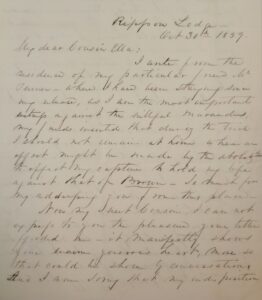
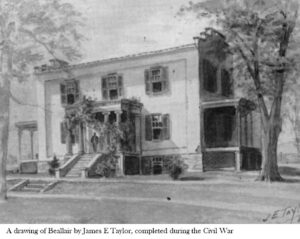 As nearby Harpers Ferry changed hands from Federal to Confederate and then back again, with troops of both sides moving in and around the estate, Beallair became untenable. To add to the problem, Ella was now pregnant and not having an easy time with her situation. Therefore, they moved to her parents’ place at Clover Lea. On August 21, 1861 Ella gave birth to Betty Lewis Washington.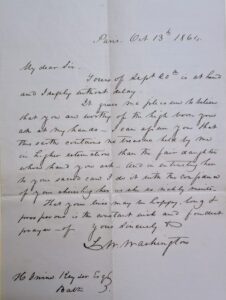
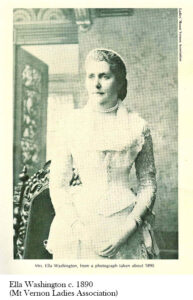 When Lewis died on October 1, 1871, it fell upon Ella to make the hard choices to maintain the Beallair estate and to cover the debts. Her pardon business had died out due to the government giving blanket pardons to former Confederates. Her wins in court did not give her enough return and, in desperation, she had to sell the artifacts of George Washington that had been passed down through the family (which were briefly stolen by John Brown’s raiders in 1859) to the New York Library Museum in 1873. Even though the items brought in a worthy sum, it was not enough to cover the accumulated debt. In 1877, Ella was ordered by the West Virginia court to sell the property to its most interested buyer, former Union officer George Washington Ziegler Black.